
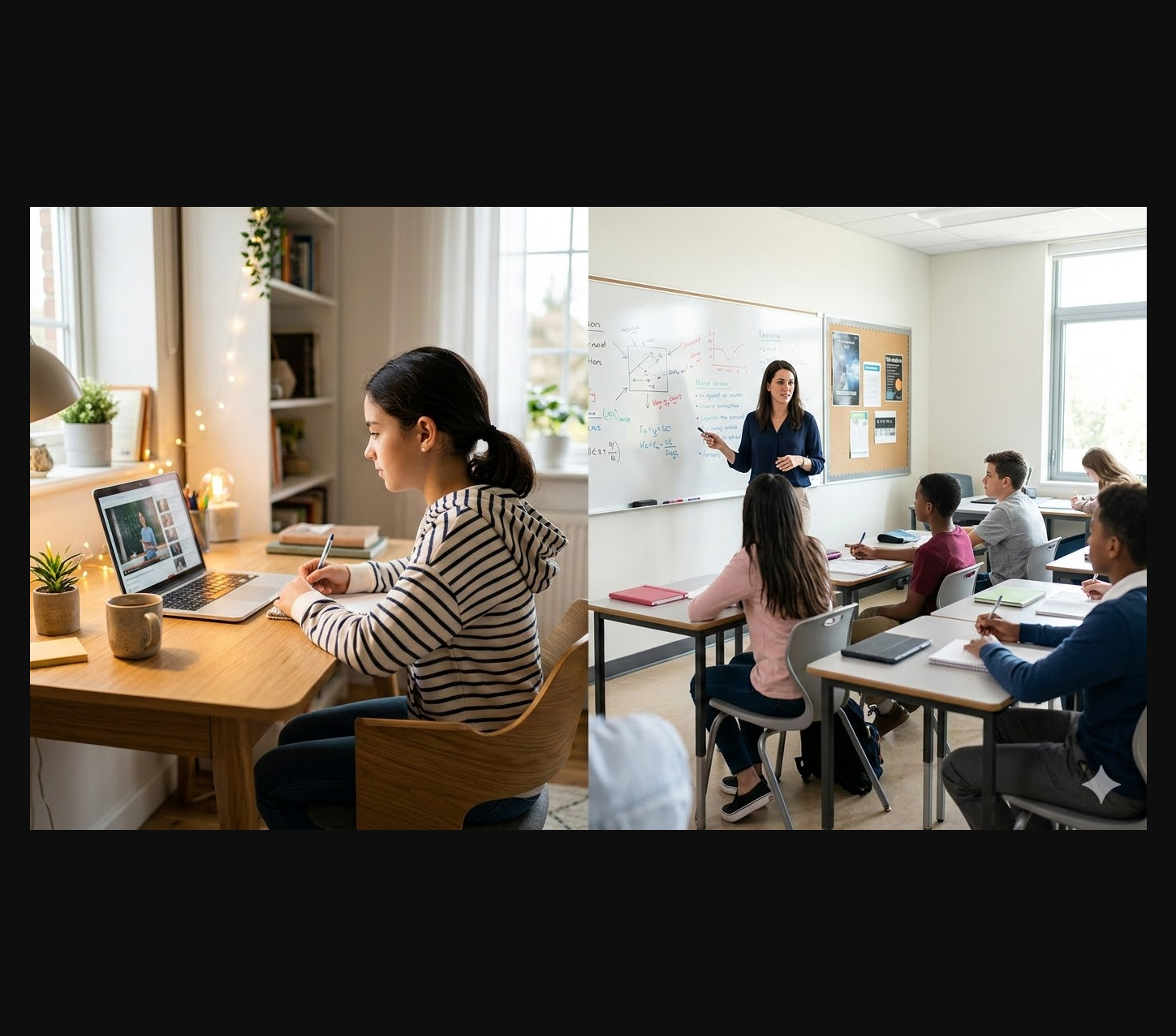
Virtual Schools vs In-Person: Pros, Cons, and Hybrid Options
Explore the pros and cons of virtual schools, traditional in-person learning, and hybrid models. This data-driven guide helps parents choose the best learning environment for their child in 2026.
Choosing the right learning environment for your child is one of the biggest decisions parents face in 2026. With virtual schools now enrolling millions of students nationwide, in-person learning evolving with new technology, and hybrid models offering the best of both worlds, families have more options than ever before. But how do you decide which format truly fits your child's needs, learning style, and family situation?
In this comprehensive guide, we break down the pros and cons of virtual schools, traditional in-person learning, and hybrid options — backed by the latest data and research — so you can make an informed choice.
What Are Virtual Schools?
Virtual schools — also called online schools or cyber schools — deliver instruction entirely through digital platforms. Students log in from home (or anywhere with internet access) to attend live classes, watch recorded lectures, complete assignments, and interact with teachers and classmates through video conferencing and messaging tools.
There are two main types of virtual schools in the K-12 space:
- Public virtual schools — Tuition-free, state-accredited programs like K12 (Stride) and Connections Academy. These follow state curriculum standards and are funded by taxpayer dollars, just like brick-and-mortar public schools.
- Private virtual schools — Paid programs that often offer smaller class sizes, specialized curricula, and more flexibility. These range from faith-based online academies to elite college-prep programs.
As of 2026, the online learning industry is growing at roughly 9.1% annually, and full-time virtual school enrollment in K-12 has stabilized well above pre-pandemic levels. Virtual schooling is no longer a pandemic stopgap — it's a permanent fixture of the American education landscape.
The Pros of Virtual Schools
1. Flexibility and Convenience
The number-one advantage families cite is flexibility. Virtual schools let students learn at their own pace, on their own schedule. This is a game-changer for:
- Student athletes who travel for competitions
- Performing artists with rehearsal and audition schedules
- Students with chronic health conditions who miss frequent in-person days
- Military families who relocate often
- Families who travel or live in rural areas with limited school options
Research shows that online learning typically requires 40-60% less time than covering the same material in a traditional classroom, largely because students can skip content they've already mastered and spend more time on challenging areas.
2. Personalized Learning Pace
In a traditional classroom, the teacher moves at the pace of the group. In a virtual school, students who grasp concepts quickly can accelerate, while those who need more time can review material without the social pressure of falling behind in front of peers.
Many virtual platforms now use AI-powered adaptive learning systems that adjust difficulty in real time, creating a truly personalized educational experience.
3. Safety and Comfort
For students dealing with bullying, social anxiety, or safety concerns, learning from home provides a stress-free environment where they can focus on academics without the emotional toll of a hostile school climate.
4. Access to Specialized Courses
Virtual schools often offer courses that small or rural school districts simply cannot staff — AP classes, foreign languages like Mandarin or Arabic, coding, and other specialized electives. Geography is no longer a barrier to curriculum quality.
The Cons of Virtual Schools
1. Social Isolation
The biggest concern parents and educators raise about virtual schooling is the lack of face-to-face social interaction. School isn't just about academics — it's where children learn to navigate friendships, resolve conflicts, collaborate on group projects, and develop emotional intelligence.
While virtual schools offer clubs, virtual field trips, and online social events, these don't fully replicate the organic socialization that happens in hallways, on playgrounds, and in cafeterias.
2. Requires Strong Self-Discipline
Virtual learning demands a level of self-motivation and time management that many younger students haven't yet developed. Without the structure of a physical school day, some students struggle to stay on task.
Data backs this up: completion rates in online courses can be 11-14 percentage points lower than in traditional settings, and the pandemic saw a 30% increase in failing grades during remote learning periods.
3. Screen Time Concerns
Full-time virtual school means students spend 5-7 hours per day on a computer — on top of any recreational screen time. This raises legitimate concerns about eye strain, sedentary behavior, and the long-term health effects of excessive screen use for developing children.
4. Digital Divide and Access Issues
Not all families have reliable high-speed internet or up-to-date devices. An estimated 15-25% of students still lack adequate access to the technology required for effective online learning. This equity gap disproportionately affects low-income and rural families.
5. Parent Involvement Requirements
Especially for elementary-age students, virtual school often requires a parent or learning coach to be present during the school day. This can be a significant burden for working parents who cannot supervise their child's learning from home.
The Pros of In-Person Schools
1. Socialization and Community
Traditional schools provide daily, in-person interaction with peers and adults. Students learn social skills organically — teamwork during group projects, conflict resolution on the playground, and leadership through clubs and student government. These soft skills are critical for long-term success.
2. Structured Routine
A set school schedule provides consistent structure that helps students develop discipline, time management, and healthy habits. For many families, the predictability of drop-off and pick-up times also makes work-life balance more manageable.
3. Hands-On Learning Opportunities
Science labs, art studios, woodshops, athletic facilities, and music rooms offer tactile, experiential learning that's difficult to replicate virtually. These hands-on experiences are especially important for kinesthetic learners who absorb information best by doing.
4. Immediate Teacher Support
In a physical classroom, teachers can read body language, notice when a student is confused, and provide immediate, personalized feedback. This real-time responsiveness is harder to achieve through a screen.
5. Extracurricular Activities
Sports teams, drama productions, debate clubs, robotics competitions, and school dances are integral parts of the in-person school experience. While some virtual schools organize meetups and events, the breadth of extracurricular options at brick-and-mortar schools is hard to match.
The Cons of In-Person Schools
1. Limited Flexibility
Traditional schools operate on a rigid schedule — typically 8 AM to 3 PM, five days a week. This leaves little room for students with non-traditional needs or families with irregular schedules.
2. One-Size-Fits-All Pacing
Classroom instruction generally moves at the pace of the majority. Advanced students may feel bored, while struggling students may feel rushed. Differentiated instruction helps, but teachers managing 25-30 students can only individualize so much.
3. Safety Concerns
From bullying to school violence, physical safety remains a concern for many parents. While schools invest heavily in safety measures and anti-bullying programs, these issues haven't been eliminated.
4. Geographic Limitations
Your child's school options are largely determined by your address. Families in under-resourced districts may have access to fewer advanced courses, less experienced teachers, and older facilities — a reality that directly ties educational quality to zip code and property values.
The Hybrid Option: Best of Both Worlds?
Hybrid learning models combine online and in-person instruction, and they've emerged as one of the most promising innovations in K-12 education. Here's how they typically work:
- Part-time hybrid: Students attend a physical school 2-3 days per week and complete online coursework the remaining days.
- Flex model: Students learn primarily online but come to campus for labs, tests, social events, and one-on-one teacher support.
- Enrichment model: Core academics happen online, while in-person time focuses on electives, arts, PE, and social activities.
Why Hybrid Is Gaining Momentum
Hybrid models address many of the shortcomings of both virtual and in-person learning:
- Socialization + flexibility: Students get regular face-to-face time with peers while maintaining the flexibility to learn at their own pace on remote days.
- Reduced screen time: Fewer full days on a computer means less eye strain and more physical activity.
- Personalized pacing: Online components allow self-paced learning, while in-person days provide teacher support and collaborative experiences.
- Better for working parents: A predictable schedule with some in-person days provides structure without requiring full-time at-home supervision.
Research from the National Education Policy Center suggests that hybrid models can achieve higher engagement rates than fully virtual programs while offering more flexibility than traditional schools. Districts in both urban and rural settings have adopted hybrid approaches to address teacher shortages and expand course offerings.
Challenges of Hybrid Learning
Hybrid isn't perfect. Schools face logistical challenges managing split populations of in-person and remote students simultaneously. Teacher workload can increase significantly, and not all districts have the infrastructure or funding to implement hybrid effectively.
For families, hybrid also requires reliable internet and devices for the online days, plus transportation to campus on in-person days — potentially the least convenient aspects of both models combined.
How to Choose the Right Option for Your Child
There's no universal "best" choice — the right learning environment depends on your child's personality, learning style, and your family's circumstances. Here are key questions to guide your decision:
Consider Virtual School If:
- Your child is self-motivated and can manage their time independently
- Your family has an irregular schedule (travel, sports, performing arts)
- Your child has health conditions that make daily attendance difficult
- You live in an area with limited school options
- Your child thrives with one-on-one attention and self-paced learning
Consider In-Person School If:
- Your child is social and energized by being around peers
- They need the structure and routine of a set schedule
- Hands-on learning (labs, arts, sports) is important to their development
- You need consistent childcare during work hours
- Your child is young and still developing self-regulation skills
Consider Hybrid If:
- You want flexibility without sacrificing socialization
- Your child benefits from both independent and collaborative learning
- You want to reduce screen time compared to full virtual school
- Your district offers a well-structured hybrid program
- You're looking for a gradual transition from traditional to online learning
How SchoolZone.ai Helps You Decide
Choosing between virtual, in-person, and hybrid schools starts with understanding what's available in your area. SchoolZone.ai uses AI-powered analysis to help parents evaluate and compare schools based on data that actually matters — not just test scores, but teacher quality, program offerings, safety records, and community reviews.
Whether you're exploring virtual academies, comparing local public schools, or researching hybrid options in your district, SchoolZone.ai gives you the comprehensive, unbiased data you need to make the best decision for your family.
The Bottom Line
The future of K-12 education isn't one-size-fits-all. Virtual schools offer unmatched flexibility and personalization. In-person schools provide irreplaceable social experiences and hands-on learning. Hybrid models bridge the gap with innovative approaches that combine the strengths of both.
The best school for your child is the one that aligns with their learning style, your family's needs, and the opportunities available in your community. Take the time to research, visit (virtually or in person), and talk to other families before making your choice.
Whatever you decide, tools like SchoolZone.ai can help you navigate the options with confidence — because every child deserves an education that fits.