
School Zoning and Boundary Changes: What Parents Should Know
How school boundary decisions get made, how to track proposed changes, and what to consider when buying a home in a school district.
School Zoning and Boundary Changes: What Parents Should Know
Last February, Howard County Public Schools in Maryland announced a boundary review affecting eleven schools—six elementary schools, three middle schools, and two high schools. The changes took effect in fall 2026, reassigning hundreds of students to new buildings. For families who had purchased homes specifically to attend those schools, the announcement felt like the ground shifting beneath them.
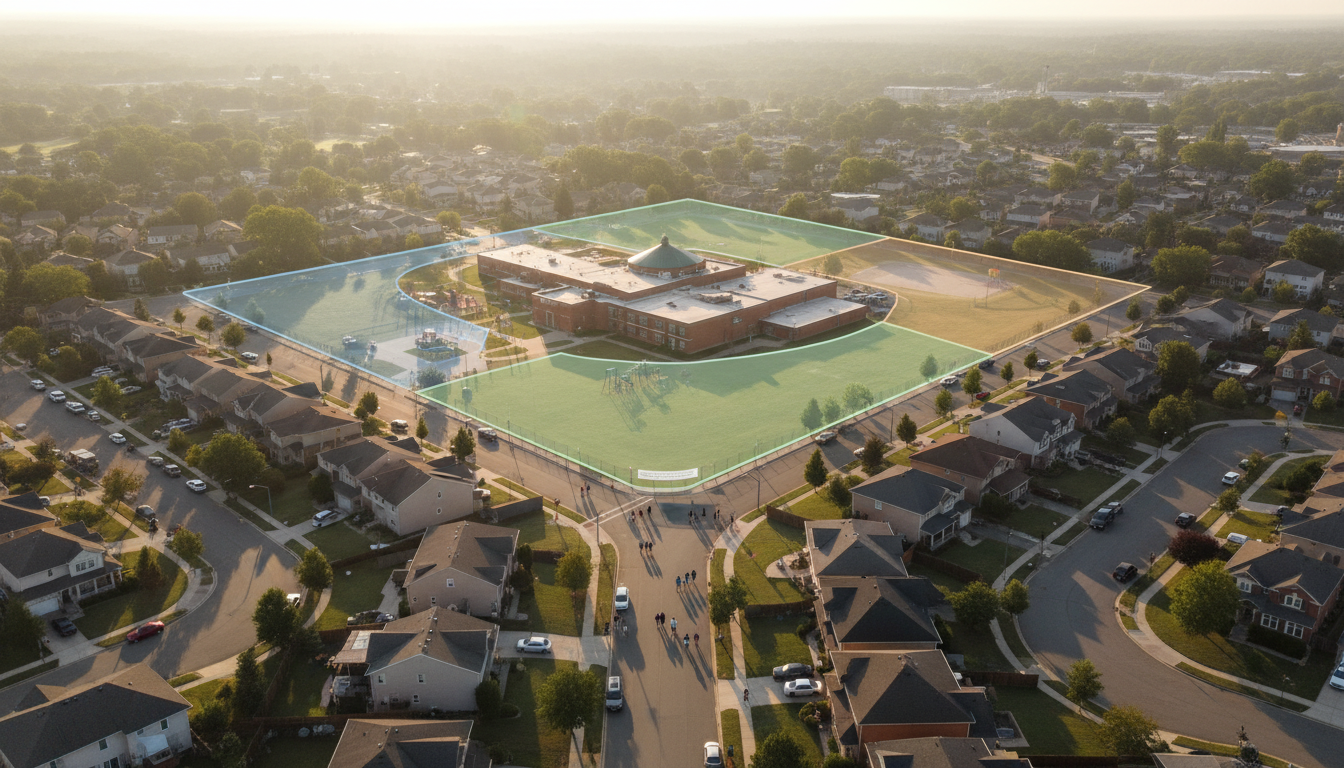
School zoning determines which public school your child will attend based on where you live. But those invisible lines on a map are not permanent. Districts redraw school boundaries regularly to respond to enrollment shifts, new construction, budget pressures, and equity goals. Understanding how these decisions get made—and how to track them before they affect your family—can help you make smarter choices about where to live and how to advocate for your community.
Why School Districts Redraw Boundaries
Districts initiate boundary reviews for a mix of practical and policy reasons. The most common driver is enrollment imbalance. When one school operates at 140 percent capacity while another sits at 70 percent, the district faces tough choices: build new classrooms, shuffle boundaries, or let overcrowding persist.
Howard County's 2026 review targeted schools "outside the capacity utilization range of 90-110%." Districts track enrollment projections using birth rates, housing construction data, student yields per new home, and historical migration patterns. These projections look ahead five to ten years, which is why you might see redistricting proposals even before a problem feels acute to families on the ground.
New school construction also triggers boundary changes. When Howard County opened New High School #13 in 2023, officials had to carve out an attendance area from surrounding high schools—a process that began in January 2022, more than a year before the first students walked through the doors.
Equity considerations increasingly shape redistricting decisions. A 2024 Wall Street Journal analysis found that over 60 percent of public school districts in metropolitan areas remain segregated by income, with boundary maps often serving as the dividing line. Some districts now explicitly prioritize integration when redrawing lines, though implementation varies widely. Minneapolis Public Schools, for example, conducted a systemwide redesign that prioritized equity alongside capacity and transportation, gathering feedback from more than 10,000 families in the process.
Fiscal pressures matter too. Lewisville ISD in Texas closed five elementary schools in 2024 and realigned attendance zones for 2025-26, citing declining enrollment and budget constraints. Operating schools below capacity wastes resources; overcrowded schools strain staff and facilities. Redistricting is often the lever districts pull to bring both sides into balance.
How Boundary Decisions Get Made
School district redistricting follows a defined process, though the timeline and specifics vary by state and district. Most processes share a common structure: data collection, community input, draft scenarios, public hearings, board deliberation, and final approval.
The process typically begins with enrollment projections and a feasibility study. District planning offices compile data on current and projected student populations, facility capacities, transportation costs, and demographic trends. Howard County's process included a comprehensive feasibility study that examined ten-year enrollment projections, student yields from housing developments, birth trends, and possible redistricting options based on policy considerations.
Community input comes next—or should. Fulton County Schools in Georgia holds three rounds of public meetings during each redistricting effort. The first round, called "Redistricting 101," educates families on the process and criteria without presenting any maps. Round One gathers input through facilitated small-group sessions. Round Two presents alternative boundary scenarios developed from community feedback and allows participants to weigh the trade-offs of each option. Only after those two rounds does staff develop a final recommendation.
Not all districts follow this model. Some present draft maps with minimal prior input, which often triggers backlash. Alexandria City Public Schools faced questions in early 2025 about "difficult to interpret" maps and concerns about transparency in its planning process. The district responded by pointing families to an interactive school site locator and emphasizing continuous dialogue with affected neighborhoods.
School boards ultimately approve boundary changes, often after multiple work sessions and public hearings. Written testimony and in-person testimony at board meetings are standard opportunities for parents to weigh in. Howard County's 2023 redistricting allowed all students, parents, staff, and community members to provide feedback via written testimony or by testifying at public hearings. The Board of Education finalized its decision in November 2022, nearly ten months after initiating the process.
Criteria for drawing boundaries vary but typically include geographic proximity, capacity utilization, projected enrollment, traffic patterns, and feeder alignment (ensuring elementary schools feed into specific middle and high schools). Fulton County explicitly lists its criteria: geographic proximity, instructional capacity, projected enrollment, traffic patterns, and school feeder alignment. Some districts also consider community cohesion and neighborhood integrity, though these goals can conflict with capacity and equity objectives.
How to Track Proposed Changes in Your District
By the time a boundary change appears in your local news, the district has often been working on it for months. Parents who want advance notice need to monitor school board agendas, enrollment reports, and district planning documents.
Start with your district's website. Most districts maintain a school planning or facilities page that posts enrollment projections, capacity studies, and boundary review timelines. Howard County publishes annual enrollment projections and maintains a page dedicated to current and past redistricting processes. If your district has published a recent feasibility study or facilities master plan, read it—those documents often signal which schools are on the district's radar for future boundary adjustments.
Attend school board meetings, or at least review the agendas and minutes. Board agendas are typically posted online several days before each meeting. Look for agenda items referencing "boundary studies," "attendance area reviews," "capacity planning," or "feasibility studies." Even a resolution directing staff to initiate a boundary review is an early signal. Howard County's Board of Education directed staff to initiate a boundary review in February 2025, giving families months of notice before draft scenarios appeared.
Sign up for district email alerts and newsletters. Many districts send updates on redistricting to families in affected areas, though some cast a wider net than others. If your district has a school planning office, check whether it maintains a separate mailing list for planning updates.
Watch for warning signs. Public notices about boundary studies, enrollment surveys sent home, community forums on capacity planning, and local media coverage of school construction or closures all suggest that boundary changes may be coming. If your child's school is operating significantly above or below capacity, it is more likely to be included in the next redistricting cycle.
Some districts use interactive mapping tools that allow families to look up their home address and see their current school assignment. These tools are helpful for checking your current zone, but they typically do not show proposed changes until the district releases draft maps. Alexandria City Public Schools directs families to an interactive school site locator to verify current assignments and explore boundary impacts by address.
What to Consider When Buying a Home
School zoning routinely appears at the top of homebuyer priority lists, especially for families with school-age children. The data on this is consistent: homes in top-rated school zones sell for a premium. Research shows that homes in highly-rated school zones sell for 5-20 percent more than comparable homes in average zones. In high-cost markets, that premium translates to tens or even hundreds of thousands of dollars.
But school boundaries are not permanent, and the premium you pay today can evaporate with a single board vote. Montgomery County, Maryland approved sweeping boundary changes in March 2026, affecting thousands of families. Realtors reported that property value impacts began when boundary changes were announced, not when they took effect, as buyers immediately factored new school assignments into purchase decisions.
Before you buy, verify the current school assignment for the specific address. Do not rely on neighborhood reputation or information from a few years ago. Use the district's official boundary map or address lookup tool. Real estate agents in Northern Virginia report that school districts "make all the difference"—one agent noted a fifty-thousand-dollar swing in lot prices depending on elementary school assignment in Vienna, and a two-hundred-thousand-dollar difference between a large home in a poorly-rated district and the same size home in a top-rated district three miles away.
Ask whether the district has any boundary reviews underway or planned. Check the district's website for feasibility studies, enrollment projections, or board resolutions directing staff to study boundaries. A home on the edge of a school's attendance zone is more vulnerable to future redistricting than one in the geographic center. District boundaries can change, and being "grandfathered in" does not always transfer to new homeowners.
Consider the feeder pattern, not just the elementary school. A strong elementary school that feeds into a weak middle school limits your home's appeal to families with older children. Look at the entire K-12 pathway. Some districts periodically adjust feeder patterns when they redistrict, so a home that currently feeds into a desirable high school may not do so in five years.
Understand what happens if boundaries change. Some districts allow students already enrolled to finish at their current school; others reassign everyone immediately. High school students often receive more protection from mid-year reassignments than elementary students. Howard County exempted rising 11th and 12th graders from its 2023 redistricting, allowing them to stay and finish at their currently assigned high school.
Weigh the district's long-term plans. Is the district growing or shrinking? Are new schools planned? Is there a history of frequent redistricting? Portland Public Schools has seen enrollment declines and is consolidating schools in response to a projected seventy-two million dollars in cuts from 2025 to 2027. Buyers in districts facing enrollment declines and budget cuts should expect more boundary volatility in the years ahead.
Finally, consider alternatives if boundary stability matters to you. Private schools, charter schools, magnet programs, and open enrollment policies offer options outside traditional attendance zones, though availability and eligibility vary widely by location. Homes assigned to higher-performing schools often command premiums, but if a district offers robust school choice options, the attendance zone premium may be smaller.
How to Participate in the Redistricting Process
If your district announces a boundary review, you have more influence over the outcome than you might think—but only if you participate early and consistently.
Show up to community input sessions and public hearings. Districts are required to provide opportunities for public comment, but the weight they give that input depends partly on how many people engage. Fulton County Schools designs its process around three rounds of community meetings specifically to maximize public input before staff drafts proposals. Attend the early meetings, not just the final hearing after the district has already developed a recommendation.
Submit written testimony to the school board. Written comments become part of the public record and allow you to make a detailed case that references specific data, criteria, or maps. Many districts accept written testimony throughout the process, not just during designated comment periods.
Focus your input on the district's stated criteria. If the district lists capacity utilization, geographic proximity, and traffic patterns as criteria, frame your concerns in those terms. Arguing that your neighborhood deserves to stay together because of community ties is more persuasive when the district has adopted "community cohesion" as a formal criterion.
Bring data. If you are advocating for a specific boundary adjustment, show how it would affect capacity, transportation costs, or feeder patterns. Districts respond to arguments grounded in the same data and projections they are using internally.
Organize with your neighbors. A petition signed by fifty families carries more weight than fifty individual emails saying the same thing. Some parent groups work with local nonprofits or hire consultants to develop alternative boundary maps that address the district's capacity concerns while minimizing disruption to their community.
Be realistic about trade-offs. Every boundary decision creates winners and losers. If you argue for keeping your neighborhood together, acknowledge which other neighborhood would absorb the enrollment instead. Districts appreciate input that recognizes the complexity of the problem they are trying to solve.
Stay engaged through the entire process. Alexandria City Public Schools emphasized that it is "committed to being transparent throughout the process, actively listening to community feedback, and addressing concerns as they arise." But transparency only works if families keep showing up to meetings, reviewing updated maps, and submitting feedback at each stage.
What Redistricting Means for Families and Home Values
Boundary changes affect more than your child's school assignment. They ripple through property values, neighborhood cohesion, and long-term planning for families and communities.
The real estate impact is immediate and measurable. When a home is rezoned from a highly-rated school to a lower-rated school, property values typically decline 3-10 percent relative to pre-change expectations. The reverse is also true—homes rezoned to better schools see corresponding appreciation. In the months following boundary change announcements, affected neighborhoods often see increased sales volume as some families sell to avoid the transition.
Portland's redistricting process drew criticism for lack of transparency in final decisions, failure to consider family needs, and insufficient attention to balancing efforts. These procedural concerns compounded the difficulty families faced in planning around the changes.
For children, redistricting can mean leaving established friendships, adjusting to new teachers and routines, and navigating an unfamiliar school culture. Districts often provide transition support—Howard County's schools hold open houses and provide information about supports and services at the new school—but the adjustment is real.
Feeder pattern changes can be especially disruptive. A child who starts elementary school expecting to attend a specific middle school with neighborhood friends may find that the feeder pattern changed by the time they reach fifth grade.
Over the longer term, boundary changes can shift neighborhood identity and cohesion. When a subdivision is split between two schools, or when a historically unified neighborhood is divided, the social ties that come from shared school events, carpools, and after-school activities can weaken.
Moving Forward
School zoning shapes educational opportunity, property values, and community life. Boundaries will continue to shift as districts respond to demographic change, fiscal pressure, and equity concerns. Many districts revise attendance boundaries every five to ten years, making boundary volatility a predictable feature of public education in growing and changing communities.
Parents who understand how the process works—who monitors enrollment trends, attends the early community meetings, reads the feasibility studies, and asks the right questions before signing a mortgage—are better positioned to navigate boundary changes when they come.
The lines on a school district map are not just administrative details. They are decisions about who has access to which resources, which children will learn together, and which neighborhoods will rise or fall in the real estate market. Those decisions are made by school boards and district administrators, but they are shaped by the families, educators, and community members who choose to participate.
If redistricting is coming to your district, the best time to get involved is now—before the maps are drawn, before the board votes, and before the moving trucks pull up to your neighbor's driveway.